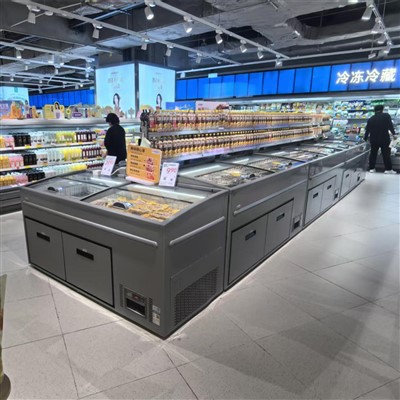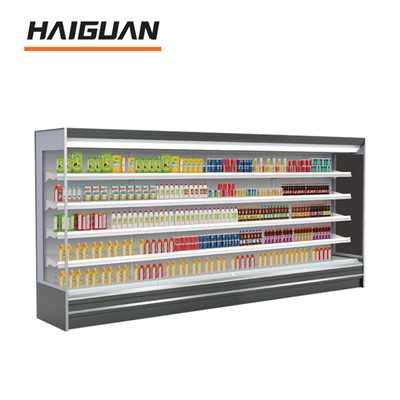
For open-type refrigerated food display cases, the air curtain primarily separates the air inside and outside the cabinet, playing a crucial role in preventing the penetration of external heat. The air curtain performance also significantly impacts the temperature and velocity distribution inside the cabinet. Researchers mainly focus on two aspects: air curtain flow and heat transfer mechanisms, and air curtain optimization.
1. Air Curtain Flow and Heat Transfer Mechanisms
The air curtain flow and heat transfer mechanisms are not only related to the air curtain outlet velocity, temperature, and initial turbulence intensity, but are also affected by spatial buoyancy and external environmental factors, making the influencing factors quite complex. After the air curtain flows out of the nozzle, it is divided into two regions: the initial section and the main flow section. In the former, the central flow velocity remains constant, while in the latter, the central flow velocity decreases. Since the initial section length and eddy viscosity of both regions are closely related to the initial turbulence intensity, these two different regions need to be considered when solving for vertical jets. Other researchers have divided the air curtain flow into three different regions: the outlet region, the development region, and the return air region, with their sealing capabilities decreasing sequentially. The first two regions are mainly affected by the air curtain outlet velocity, while the third region is mainly affected by the structure of the air curtain return air outlet. In the outlet region, the air curtain flow velocity is high and directional; the starting point and direction of flow in the development region are mainly influenced by the outlet region; and the flow direction in the return air region is significantly distorted under the influence of the suction effect of the return air outlet. Computational fluid dynamics (CFD) is an effective technique for improving the structure of refrigeration equipment and optimizing the internal flow field, allowing for the simulation of detailed temperature and flow fields within the flow region. Some scholars have simulated the airflow organization velocity and temperature distribution inside cold storage using CFD technology, providing theoretical references for optimizing fan settings and the placement of goods in cold storage. Zhao Xinxin et al. studied the influence of guide rails in refrigerated truck compartments on the temperature distribution inside the compartment through numerical simulation, providing theoretical guidance for optimizing the performance of single-evaporator multi-temperature zone refrigerated trucks.
In recent years, CFD technology has been widely used in refrigerated display cases. Yu Kezhi et al. used a two-fluid model to numerically simulate the air curtain of a vertical display cabinet. Compared with the K-ε turbulence model, the calculation results of this model are more consistent with the experimental values.
2. Air Curtain Optimization
The main parameters affecting the performance of refrigerated display cabinets include honeycomb structure, air curtain height, air curtain thickness, and air outlet velocity. Since the velocity distribution, turbulence intensity, and thickness of the air curtain are closely related to the structure of the air outlet, the structure of the display cabinet's air outlet is a major factor affecting air curtain performance. In practical applications, a honeycomb structure is often used in the air curtain outlet to reduce excessive turbulence intensity. To achieve appropriate turbulence attenuation, the ratio of the length to the aperture of the honeycomb structure should be greater than 10.
The air curtain flow pattern formed by the top air supply of the cabinet is related to factors such as air supply speed, height, and air curtain thickness. When the air curtain height is 300 mm, the wind speed should reach at least 0.6 m/s; when the height is 800 mm, the wind speed needs to reach 2 m/s to form a stable air curtain with an aspect ratio of 1/5. Increasing the air curtain thickness can improve the ability of the air curtain to seal the open area, but excessive air curtain thickness will cause cold loss and increase the energy consumption of the refrigerated display cabinet. Therefore, the thickness of the air curtain outlet is usually controlled between 50 and 80 mm. Some scholars have also used particle image velocimetry and infrared imaging technology to conduct numerical simulations and experimental studies on the flow characteristics of the air curtain, and proposed some effective measures to optimize the air curtain. Cao et al. used an improved two-fluid model and a cold loss two-fluid model to numerically simulate the heat transfer and flow of the air curtain and its surrounding air, rationally optimizing the air curtain and improving the performance of the display cabinet.
Currently, researchers mainly focus on the study of mechanisms and numerical studies of the air curtain performance of refrigerated display cabinets. However, numerical simulation still has certain limitations in understanding the flow and heat transfer mechanisms and optimization process of the air curtain. The jet model, laminar flow model, Reynolds stress model, and two-fluid model developed in the literature are only applicable to their respective specific conditions. In particular, two-dimensional steady-state models are commonly used in numerical calculations, which cannot study more complex situations closer to the actual environment. Therefore, further improvements in research methods and experimental schemes are needed in future research.