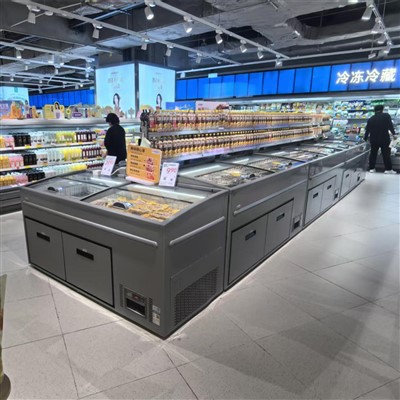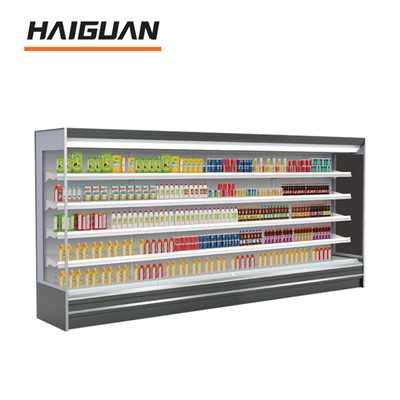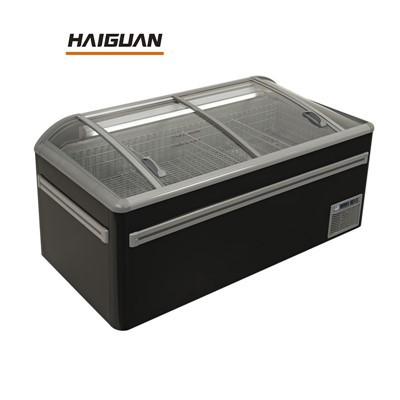
The internal structure of a refrigerated display cabinet significantly impacts airflow and temperature distribution within the cabinet. Researchers have primarily analyzed the effects of optimizing the back panel and shelves on temperature distribution and airflow.
1. Influence of Back Panel Structure
In a refrigerated display cabinet, a portion of the cold air is directed to the air curtain, while another portion is delivered to the cabinet interior through the back panel to cool the food. An unreasonable distribution of airflow between these two paths increases the energy consumption of the refrigerated display cabinet. Inadequate airflow from the back panel can increase the temperature difference between the inner and outer food packages and weaken the air curtain's ability to resist external heat penetration. Adjusting the back panel's perforation rate can improve the uneven temperature distribution between cabinet layers. The back panel perforation rate is usually controlled between 1% and 2%. 70% to 80% of the back panel's airflow enters the air curtain return vent. At the lower shelves, the air curtain thickens but its intensity weakens, requiring airflow from the back panel to cool the outer food packages and effectively resist heat penetration. Although the air curtain's resistance to heat penetration is significant, the influence of the back panel perforation rate on the cabinet's internal temperature distribution cannot be ignored. When the airflow ratio between the air curtain and the back panel is maintained at 30% to 70%, it helps ensure the stability of the display cabinet's air curtain and the uniformity of the velocity and temperature fields within the cabinet. Wu et al. analyzed the impact of back panel perforation rate and location on the temperature of inner and outer food packages in the cabinet, concluding that reasonable adjustment of the back panel perforation location between the shelves of each layer is beneficial for uniform temperature distribution within the cabinet. They proposed an improved model, suggesting that when the back panel perforation rate is between 2% and 3%, and the airflow is around 30%, the refrigerated display cabinet system performs better.
2. Influence of Shelf Structure
The arrangement of food inside the refrigerated display cabinet, the width of the shelves, and their installation position all affect the airflow within the cabinet and the stability of the air curtain flow. Changing the typical horizontal arrangement of food in supermarkets to a stepped arrangement can reduce the temperature difference between the front and back of the food on each shelf. The size and position of the shelves inside the cabinet have a significant impact on the temperature distribution, airflow pattern, and heat load within the cabinet. The presence of shelves can expand the range of the Richardson number that ensures stable airflow and improve the stability of the airflow. To address the problems of poor heat transfer performance and uneven temperature distribution in ordinary shelves, researchers have proposed optimizing them by using hollow shelves and adding heat pipes to the shelves. Clodic et al. designed a hollow shelf with heat exchange capabilities and connected it to the cold air channel. The new design of the hollow shelf effectively improved the airflow distribution inside the cabinet and enhanced the uniformity of the temperature distribution. However, due to the complex structure of this shelf, the flexibility of shelf installation and the cost were significantly affected.
In the use of food refrigeration display cabinets, the problem of cold air leakage from the air curtain occurs, especially when the air curtain outlet velocity is too high. A large amount of cold air leaks out of the cabinet at the air curtain return opening, resulting in energy waste and causing discomfort to shoppers, creating a cold aisle effect. Research on the cabinet structure of refrigerated display cabinets generally focuses on the back panel, shelves, and air curtain outlet, while there is less research on the air curtain return opening structure. Therefore, comprehensively considering the influence of factors such as the back panel, shelves, air curtain outlet, and air curtain return opening on the performance of food refrigeration display cabinets is of great research significance.