The impact of ambient temperature and humidity on the performance of refrigerated display cases
Changes in indoor ambient temperature and humidity affect both the temperature and humidity characteristics inside the display case and the power consumption of the refrigeration system.
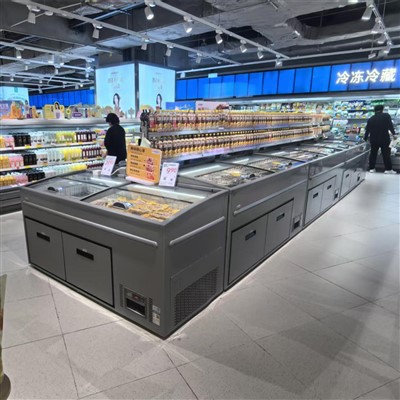
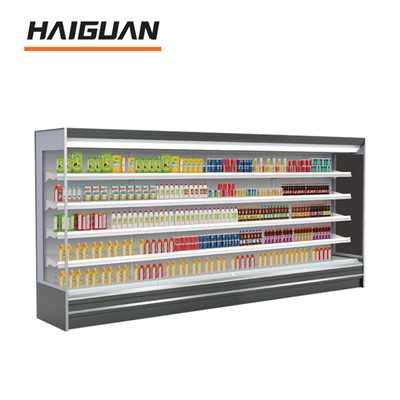
Among all the heat loads of a refrigerated display case, the infiltration heat load accounts for the largest proportion. This is mainly caused by the heat and moisture exchange between the air curtain outlet jet and the outside ambient air. The temperature and relative humidity of the ambient air not only significantly affect the heat load of the refrigerated display case but also affect the temperature of the food packages inside the case. For horizontal open refrigerated display cases, for every 1°C increase in ambient temperature, the average food package temperature increases by 0.1~0.3°C, and for every 20% increase in humidity, the average temperature increases by 0.1~0.7°C.
To reduce the impact of the dehumidifying pre-cooler on the air curtain supply and return air conditions, the results show that when the air curtain return air temperature decreases by 5°C, the relative humidity of the inner layer air curtain supply and return air remains basically unchanged, while the relative humidity of the outer layer air curtain supply air decreases from 69% to 60%, and the enthalpy value of the outer layer air curtain return air decreases by 21.4%. The reduction in air curtain return air temperature and enthalpy value can effectively reduce the heat load of the display case. Fu Tao et al. conducted a comparative experiment on display cases with and without energy-saving curtains. The results showed that with energy-saving curtains, the average relative humidity inside the display case increased by 5.74% compared to without energy-saving curtains, and the average temperature decreased by 0.43°C. Therefore, energy-saving curtains can effectively reduce the fluctuation range of relative humidity and temperature inside the display case. Therefore, energy-saving curtains should be used during non-business hours in supermarkets to reduce the impact of the outside environment on the temperature distribution of food inside the display case.
The ambient temperature and humidity outside the food refrigerated display case have a significant impact on the temperature distribution, velocity distribution, and heat load of the display case. When the ambient temperature and relative humidity decrease, the power consumption of the display case will decrease, but it will increase the load on the supermarket's air conditioning system. Therefore, there is an optimal temperature and relative humidity value that minimizes the total power consumption of both the food refrigerated display case and the supermarket's air conditioning system, which requires further in-depth research.